Kinematics has four equations
V = Vo - at ; has no position variable
X – Xo = ½ (V – Vo)t ; has no acceleration variable
X – Xo = ½ (V – Vo)at2 ; has no velocity variable
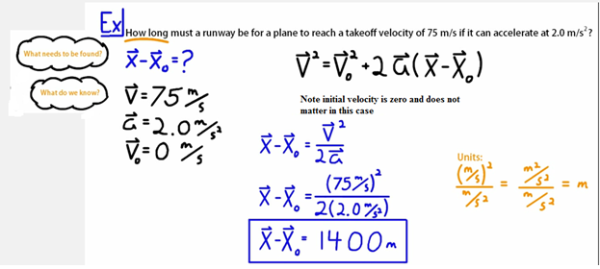
V2 = V2o + 2a(X – Xo) ; has no time variable
Works only if there is uniform equation
V = Velocity
Vo = Final velocity
X = Initial position
Xo = Final position
A = acceleration
The below tells us, how much an object changes from here to there or form V0t to 1/2at2
∆x= V0t + 1/2at2
In real world, we have ‘g’ as gravity for ‘a’
g = 10m/s2 (meters per second square)
V = Vot + at => a = ∆x/∆t ; Final velocity less initial velocity is ∆x, divided by t
V2 = V2o + 2a∆x or v V2 = Vo2 + 2a(x-xo)
Here is a relationship between final velocity, initial velocity, acceleration and the distance travelled ∆x. x-xo is also
displacement or change in position.
V = Vo - at ; has no position variable
X – Xo = ½ (V – Vo)t ; has no acceleration variable
X – Xo = ½ (V – Vo)at2 ; has no velocity variable
V2 = V2o + 2a(X – Xo) ; has no time variable
Works only if there is uniform equation
V = Velocity
Vo = Final velocity
X = Initial position
Xo = Final position
A = acceleration
The below tells us, how much an object changes from here to there or form V0t to 1/2at2
∆x= V0t + 1/2at2
In real world, we have ‘g’ as gravity for ‘a’
g = 10m/s2 (meters per second square)
V = Vot + at => a = ∆x/∆t ; Final velocity less initial velocity is ∆x, divided by t
V2 = V2o + 2a∆x or v V2 = Vo2 + 2a(x-xo)
Here is a relationship between final velocity, initial velocity, acceleration and the distance travelled ∆x. x-xo is also
displacement or change in position.

Mian Systems LLC
Directional Derivatives (Contd.)
 |
 |
Source: Unknown